
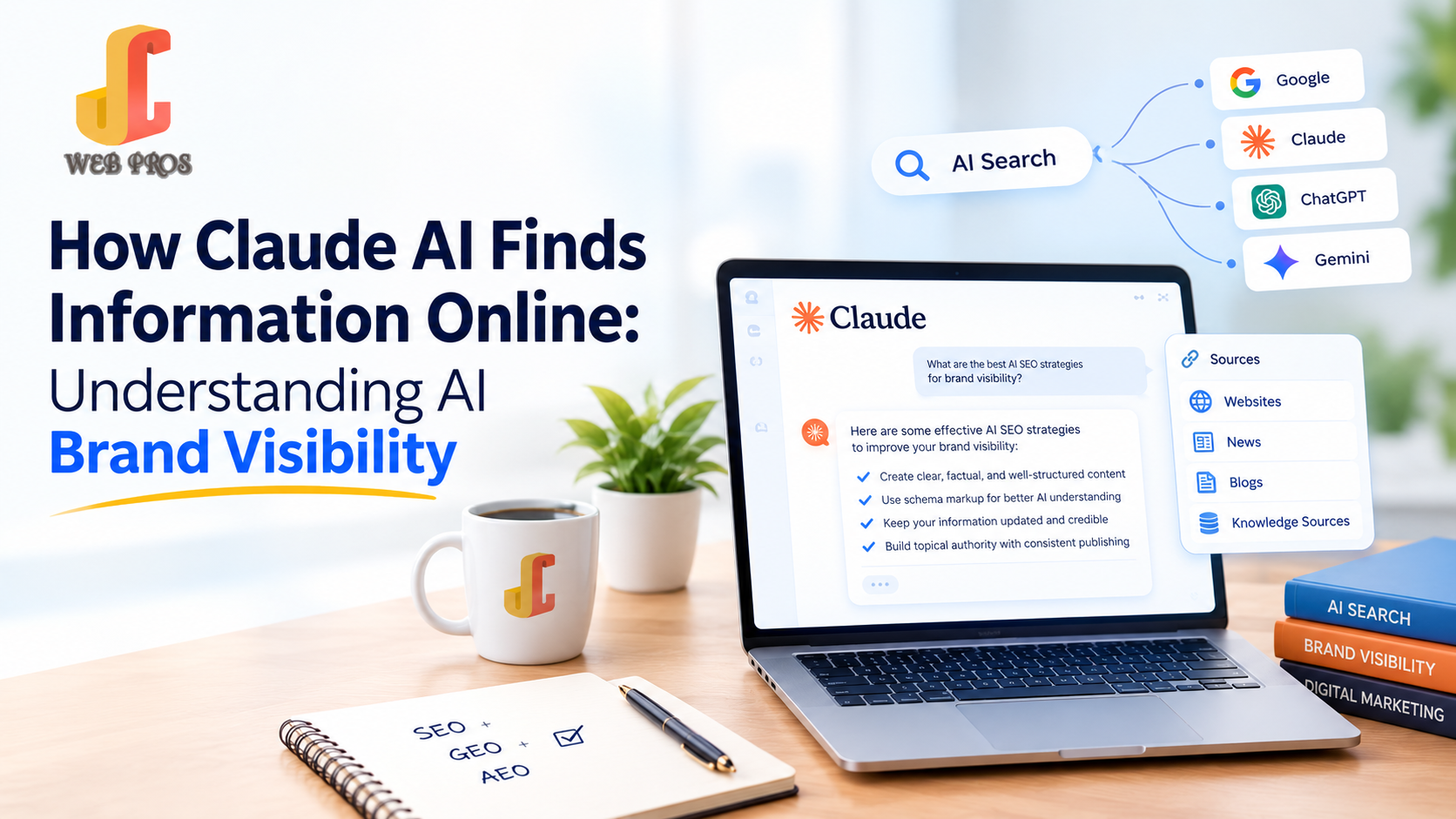
Claude answers from its training data and runs live web searches when a question needs current information. It reads the pages it finds, judges which sources are credible and recent, and combines them into one direct answer, often with citations. Brands get cited more often when their content is clear, factual, well-structured, up to date and marked up with schema, and when robots.txt doesn’t block Claude’s crawlers.
Search is no longer just about ranking on Google. It’s about being the answer AI gives, and Claude is quickly becoming one of the platforms deciding that answer.
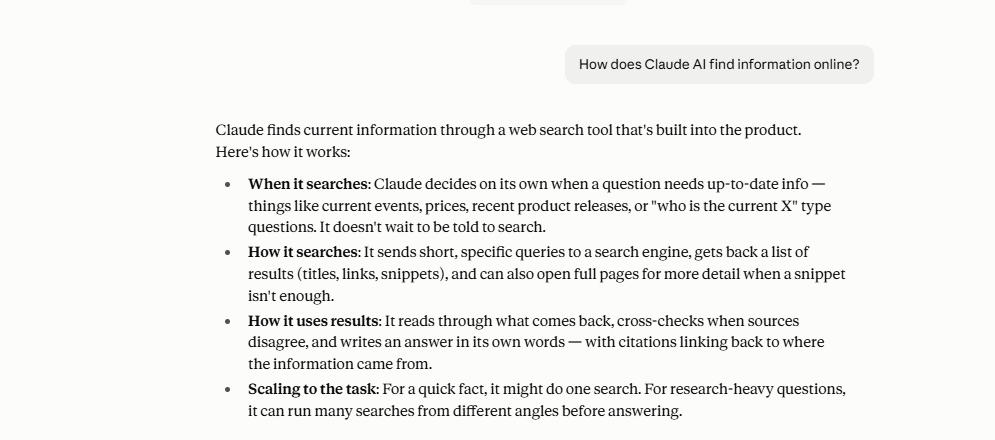
Claude chat interface: direct AI answers instead of search results.
AI chatbots have changed how people search. Instead of scrolling through search results, users now ask tools like Claude, ChatGPT, and Gemini a direct question and get a synthesized answer. From Claude AI search to how it reads images, documents, and web pages, understanding this process is becoming essential for brands. Being “found” by an AI model is now just as important as ranking on Google, which is why JC Web Pros helps businesses stay visible across Google and other AI-powered search experiences through AI SEO, GEO, and AEO strategies.
What Is Claude AI?
Claude is an AI assistant developed by Anthropic, designed to have natural conversations, answer questions, and help with research, writing, and coding tasks. Unlike a traditional search engine, Claude doesn’t just list links; it reads, synthesizes, and explains information in plain language.
Quick facts about Claude’s reach (2026 data):
- Claude has grown to an estimated 245 million monthly active users across web and mobile, per Sensor Tower’s 2026 State of AI report
- Anthropic continues to serve 300,000+ business customers, with enterprise accounts spending $1M+ annually now surpassing 1,000, up from 500 just a year earlier
- Business customers account for roughly 80% of Anthropic’s revenue
- Claude integrates with Google Workspace, allowing it to reference Gmail, Calendar, and Docs
How Claude Finds Answers: 4 Steps
- Trained knowledge: Claude learned language and facts from a huge amount of text during training. For general topics and core concepts, it answers from this learning, but its knowledge has a cutoff date and can be wrong.
- Live web search: For current events, prices, or recent updates, Claude can use a web search tool to find and read relevant pages. Claude decides on its own when a search is needed.
- Source evaluation: Claude weighs the pages it finds, leaning toward clear, credible, up-to-date sources and noting when sources disagree. It’s not perfect, so important facts are worth double-checking.
- Synthesis: Instead of a list of links, Claude combines what it found into one readable answer, often with sources you can open.
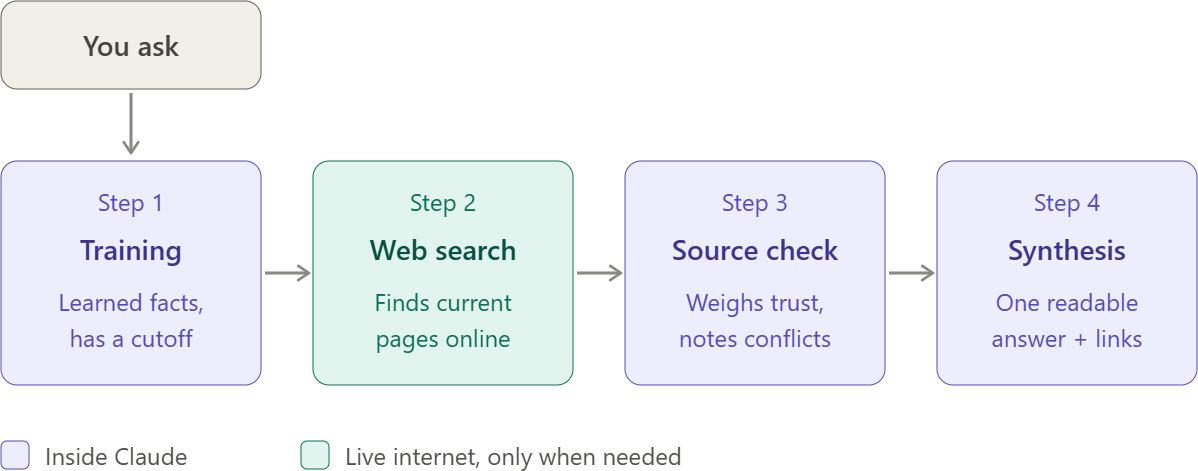
How Claude AI Search Works
As the four steps above show, live web search is what lets Claude go beyond its training data. When a question involves recent news, product comparisons, or current pricing, Claude searches the web, opens relevant pages, and reads them before answering.
A few things set this apart from a traditional search engine:
- For complex questions, Claude can chain multiple searches together, refining each one based on what earlier results turned up
- It reads the content of the pages it finds instead of simply listing them
- Clear, well-structured, factual content is generally easier for it to read and cite
Claude running a live web search for “latest iPhone price” and returning a synthesized, direct answer instead of a list of links.
Can website owners control what Claude accesses?
Yes. According to Anthropic’s Help Center, Claude uses three separate crawlers, and each one can be managed through your robots.txt file:
- ClaudeBot: collects public web content that may be used to train Anthropic’s AI models
- Claude-User: fetches a page when a Claude user asks a question that needs it
- Claude-SearchBot: improves the quality of Claude’s search results
Blocking one does not block the others. Blocking ClaudeBot only excludes your future content from training data. Blocking Claude-User or Claude-SearchBot, however, may reduce your site’s visibility in Claude’s search answers. If your brand never shows up, checking your robots.txt is a good first step.
Beyond Text: How Claude Reads Images, Videos, and Files
How Claude Reads Images (Vision)
Claude doesn’t just extract raw text from an image; it interprets diagrams, UI screenshots, charts, dashboards, and even handwritten notes in photos.
- Supported formats: PNG, JPEG, GIF, and WebP, uploaded via chat, the console playground, or base64/URL blocks in the API
- Best practice: Performance improves when images are placed before the text prompt in the message structure
How Claude Processes Videos
Claude cannot natively accept or “watch” raw video files (like .mp4 or .mov) directly in standard chat without preprocessing.
- To analyze a video, key chronological frames are extracted (duplicate or unchanging frames are dropped), and a timestamped audio transcript is generated separately
- Claude then reads the sequence of frame images alongside the transcript text to reason about actions, slides, and dialogue
- In short: Claude understands videos indirectly, through frames and transcripts, not by watching them directly
How Claude Reads Files and Documents
Claude reads structural elements like tables, data columns, and text hierarchy inside documents such as PDFs, Word docs, spreadsheets (CSV/Excel), and text files.
- For data files like CSVs or spreadsheets, Claude can use built-in code execution to calculate metrics, track trends, and even generate interactive data visualizations
How Claude AI Selects and Cites Sources
Not every website gets used equally. Claude tends to favor content that is clear, well-organized, credible, and recently updated. According to Anthropic spokesperson Michael Aciman, Claude is designed to surface accurate, balanced, reliable information, and to note when claims are disputed or when sources may conflict or carry a particular viewpoint.
What this means for source selection:
- Facts and data-backed statements are prioritized over generic claims
- Direct, well-organized answers are easier for Claude to evaluate and cite
- Overly promotional or vague content is less likely to be cited
- Recency matters; outdated pages lose visibility over time
How to Check If Claude Mentions Your Brand
Most businesses guess whether they show up in AI answers. You don’t have to; you can test it yourself in under five minutes.
Open Claude and try these prompts with your own brand and industry swapped in:
- “Best real estate company in Mohali”
- “Compare your brand vs your top competitor.”
- “What do people say about your brand?”
What to look for in the response:
- Does Claude mention your brand at all, or only competitors?
- If mentioned, is the information accurate and current?
- Does Claude cite a source, and is it your own website, or a third-party listing?
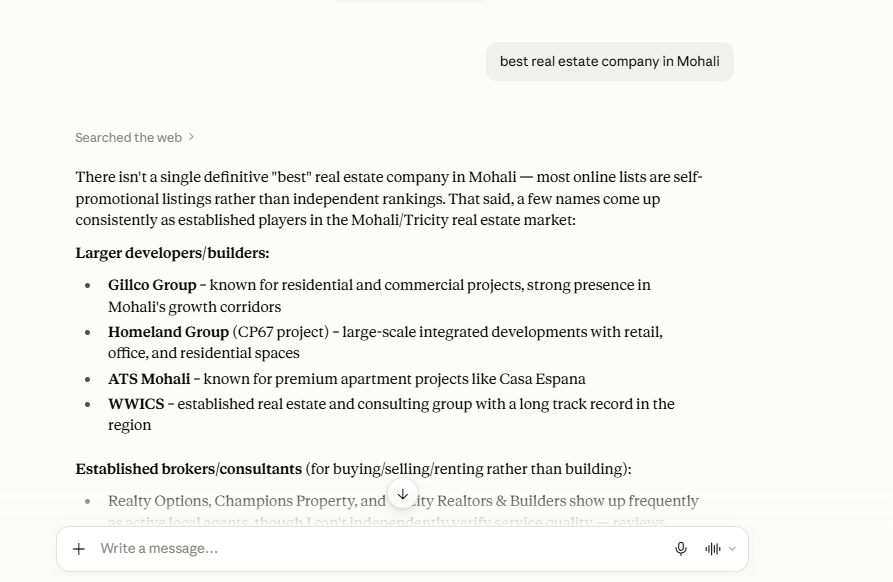
Claude’s response to ‘best real estate company in Mohali’, testing how brand visibility appears in AI-generated results.
If your brand doesn’t appear, or the details are outdated, that’s a direct signal your content isn’t structured the way Claude prefers. This is exactly what JC Web Pros’ AI Brand Visibility Audit checks for, at scale, across multiple query types.
How to Improve Your AI Brand Visibility on Claude
Improving how often Claude surfaces your content isn’t about tricking an algorithm; it’s about making your content genuinely easy for an AI to understand and trust.
Practical steps that work:
- Write direct, factual answers early in your content, not buried under fluff
- Use clear headings and schema markup, so AI models can parse sections easily
- Keep information current; Claude favors recently updated, accurate content
- Build topical authority through consistent, credible publishing
- Get regular visibility audits to track how often your brand appears in AI answers
Brands that treat AI visibility as an extension of good content practices perform better over time, since these same qualities also strengthen traditional SEO. This is the exact approach JC Web Pros takes with clients: combining SEO, AEO, and AI consulting into one connected strategy.
Conclusion
Claude AI represents a shift in how information is discovered and consumed online. It doesn’t just list pages; it searches, reads, and synthesizes them into direct answers, which means source credibility and clarity matter more than ever. Brands that test their own visibility, fix the gaps, and structure content the way AI models actually read it will stay ahead as this shift continues. JC Web Pros helps businesses do exactly that, staying visible not just on Google, but everywhere their customers are searching, including inside AI assistants like Claude. Contact us for more information.


Share This Post :