
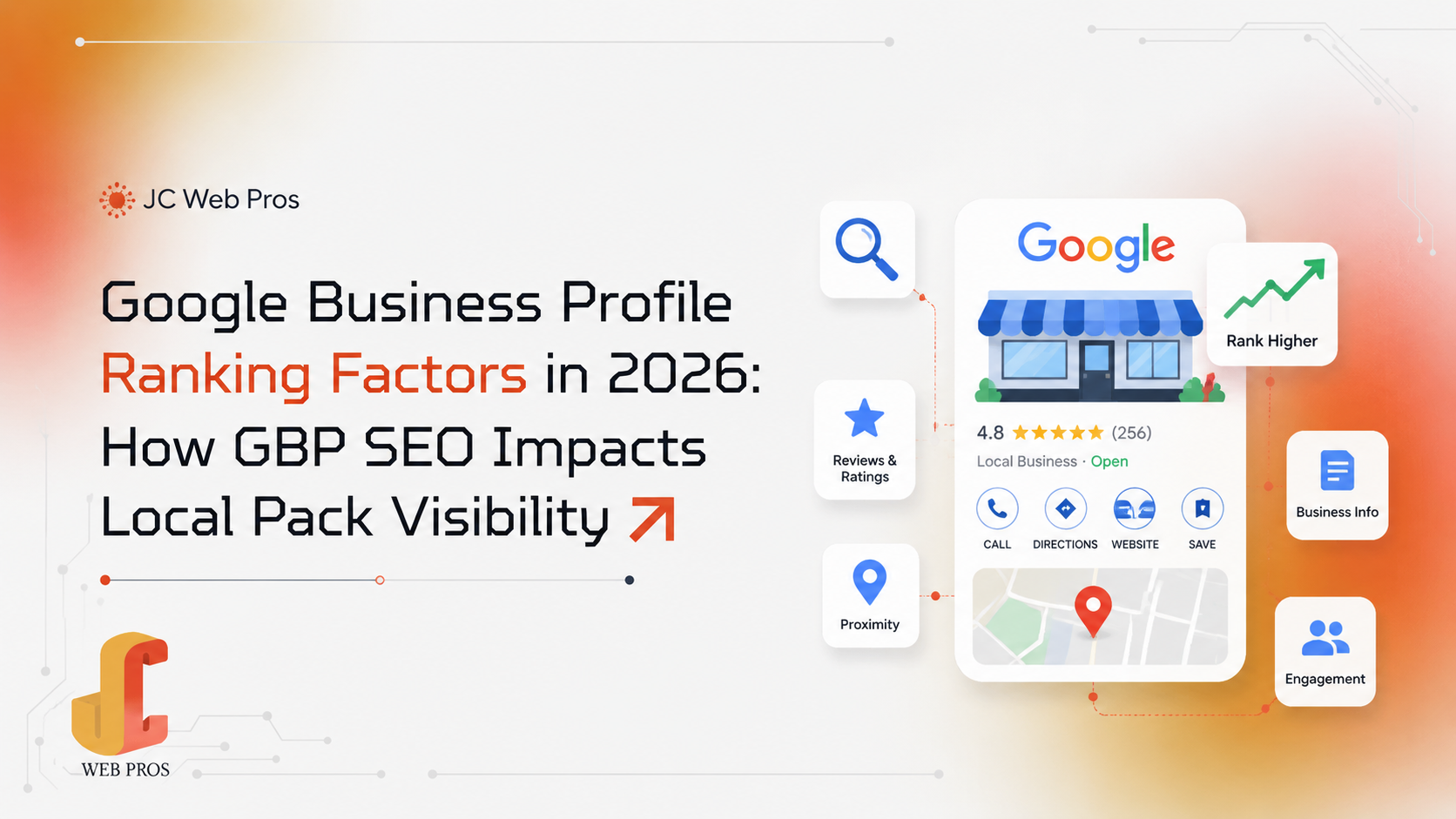
Google Business Profile optimisation remains one of the most important local SEO strategies in 2026. Google uses business categories, reviews, engagement signals, website relevance, citations, and AI-driven trust signals to determine local pack and Google Maps rankings. Businesses that maintain accurate profiles, generate consistent reviews, and optimise for local relevance are more likely to improve visibility and attract local customers.
Local search has evolved significantly over the past few years, and in 2026, businesses can no longer rely on basic optimisation tactics to appear in Google’s local results. Today, Google Business Profile (GBP) optimisation plays a major role in determining how businesses rank in the Local Pack, Google Maps, and AI-driven search experiences.
With Google increasingly using AI to interpret search intent and user behaviour, businesses must focus on relevance, trust, proximity, and engagement signals to maintain strong local visibility. From reviews and business categories to behavioural metrics and content consistency, every detail inside a Google Business Profile contributes to local search performance.
If you want to improve your visibility in Maps and local search, understanding modern Google Business Profile ranking factors is essential.
For a broader overview of local ranking signals, visit our pillar guide on Local SEO Ranking Factors 2026.
What is Google Business Profile SEO?
Google Business Profile SEO refers to the process of optimising your Google Business Profile to improve visibility in local search results, Google Maps, and the Local Pack.
A properly optimised profile helps Google understand:
What your business offers
Where your business operates
Which searches your business is relevant for
How trustworthy and active your business appears
GBP SEO is now one of the most influential components of local search optimisation because Google uses Business Profile data directly within its AI-powered local ranking systems.
When someone searches for services “near me” or location-based queries such as “best plumber in Dallas” or “coffee shop near downtown,” Google evaluates Business Profiles using multiple ranking signals before displaying results.
This means your profile needs to be accurate, complete, active, and aligned with your overall online presence.
Businesses investing in GBP optimization typically experience:
Increased visibility in Google Maps
Higher local pack rankings
More phone calls and website clicks
Increased direction requests
Better customer trust through reviews
Stronger conversion rates from local searches
GBP SEO also supports broader local SEO strategies by reinforcing location relevance and trust signals across the web.
To strengthen your local search presence further, explore our Local SEO Services.
Top GBP Ranking Factors in 2026
Google continuously updates how local rankings work, but several core Google Business Profile ranking factors remain critical in 2026.
1. Primary and Secondary Categories
Your primary business category remains one of the strongest relevance signals in Google Maps SEO.
Choosing the wrong primary category can severely limit visibility, even if your business is well established.
Businesses should:
Select the most accurate primary category
Add relevant secondary categories
Avoid category stuffing
Review category updates regularly
Google uses categories to match businesses with local intent searches, making category optimisation foundational for local pack ranking.
2. Business Name Relevance
Keywords in the actual legal business name can still influence rankings, although Google continues cracking down on spammy naming practices.
Businesses that artificially add keywords to their profile names risk profile suspensions and ranking drops.
Instead of keyword stuffing, focus on:
Consistent branding
Strong service relevance
Optimised profile content
High engagement signals
Authenticity matters more than manipulation in modern GBP SEO.
3. Review Quality, Quantity, and Velocity
Reviews continue to influence both rankings and conversions.
Google evaluates:
Total number of reviews
Average rating
Review recency
Keyword relevance within reviews
Owner responses
Review velocity over time
Businesses that consistently generate authentic customer reviews tend to perform better in both Maps rankings and click-through rates.
A steady flow of positive reviews also supports trust signals used by Google’s AI systems.
4. Proximity to the Searher
Proximity remains a major Google Maps ranking factor.
Google prioritises businesses closest to the user when relevance and authority are similar.
While businesses cannot control physical location, they can improve local relevance by:
Building location-focused landing pages
Creating hyperlocal content
Maintaining consistent citations
Earning backlinks from local organisations
Using service-area optimisation effectively
Local relevance often helps businesses compete beyond strict proximity limitations.
5. Website and On-Page Signals
Your website still plays a major role in GBP SEO.
Google cross-references Business Profile information with your website content to verify legitimacy and relevance.
Important website signals include:
Local landing pages
NAP consistency
Internal linking structure
Schema markup
Local keywords
Mobile usability
Page speed
Service relevance
Google increasingly evaluates business entities holistically, meaning your website and GBP must align perfectly.
6. Behavioural Engagement Signals
Google tracks how users interact with your Business Profile.
Important engagement metrics include:
Click-through rates
Direction requests
Phone calls
Website visits
Photo views
Messaging interactions
Booking actions
High engagement signals tell Google that users find your listing useful and trustworthy.
Profiles with better engagement often gain stronger local visibility over time.
7. Photos and Visual Activity
Businesses with active visual content generally outperform inactive profiles.
Regularly updated photos improve:
User trust
Profile engagement
Click-through rates
Time spent on profile listings
Businesses should upload:
Team photos
Interior and exterior images
Service photos
Product images
Before-and-after visuals
Geo-relevant images
Fresh visual content supports ongoing profile activity signals.
8. GBP Posts and Updates
Google Business Profile posts continue contributing to profile freshness and engagement.
Although posts may not directly influence rankings strongly, they improve:
User interaction
Conversion opportunities
Profile completeness
Trust signals
Posting updates regularly demonstrates business activity and relevance.
9. Local Citations and NAP Consistency
Consistency across business listings remains important.
Google compares your:
Business name
Address
Phone number
Website URL
across directories and citation sources to verify legitimacy.
Inconsistent citations can weaken trust signals and negatively affect local pack ranking.
Businesses should audit listings regularly to ensure uniformity across all platforms.
10. Backlinks and Local Authority
Backlinks remain an important trust signal for local SEO.
Local backlinks from:
Community organisations
Local newspapers
Industry associations
Sponsorships
Chambers of commerce
Local blogs
help strengthen geographic relevance and business authority.
Google increasingly values real-world prominence as part of local ranking algorithms.
Reviews and Local Visibility
Reviews influence far more than reputation management.
In 2026, reviews contribute directly to:
Local rankings
AI-generated local recommendations
Consumer trust
Conversion rates
Entity authority
Google’s AI systems analyse review sentiment, topical relevance, and behavioural patterns to better understand business quality.
For example, repeated mentions of specific services, staff names, products, or experiences help Google associate your business with relevant local searches.
How Reviews Support GBP SEO
Reviews help Google identify:
Service quality
Business popularity
User satisfaction
Industry expertise
Geographic relevance
Businesses with detailed, authentic customer feedback often perform better than competitors relying on minimal or generic reviews.
Best Practices for Generating Reviews
Effective review strategies include:
Asking customers shortly after service completion
Sending direct review links
Responding to every review professionally
Encouraging detailed customer feedback
Avoiding incentivised or fake reviews
Consistency matters more than sudden spikes in review activity.
Google values natural review growth patterns over manipulated behaviour.
Responding to Reviews Matters
Owner responses contribute to trust and engagement signals.
Responding professionally demonstrates:
Customer care
Active management
Business legitimacy
User engagement
Review responses also create additional keyword relevance naturally when discussing services or locations.
How AI Uses GBP Data
AI-driven search experiences are transforming local SEO rapidly.
Google increasingly uses artificial intelligence to interpret:
User intent
Search context
Behaviour patterns
Entity relationships
Local relevance
Trustworthiness
This means Google Business Profile data now feeds directly into AI-generated local recommendations and local pack rankings.
AI and Entity Understanding
Google no longer relies only on keywords.
AI systems evaluate businesses as entities using connected data across:
Business profiles
Websites
Reviews
Citations
Social mentions
User engagement
Local links
Businesses with stronger digital entity consistency typically gain better visibility.
AI-Powered Local Pack Personalisation
Local search results are becoming increasingly personalised.
Google evaluates:
User location
Search history
Preferences
Device behaviour
Time of day
Real-world popularity signals
AI uses this information alongside GBP data to determine which businesses appear most relevant for individual users.
This means businesses must optimise beyond basic keywords and focus on delivering genuine user value.
Conversational Search and Local SEO
Voice search and conversational AI are also influencing Google Maps SEO.
Users now search using natural language phrases such as:
“Best family dentist near me open Saturday”
“Top-rated HVAC repair company nearby”
“Reliable emergency electrician in my area”
Google’s AI systems analyse Business Profile data, reviews, categories, and website content to answer these conversational queries accurately.
Businesses should optimise for natural language relevance rather than exact-match keyword stuffing.
AI and Review Sentiment Analysis
Google increasingly analyses customer sentiment using AI.
It evaluates:
Emotional tone
Service mentions
Experience quality
Common themes
Positive and negative patterns
This helps Google identify businesses delivering consistently strong customer experiences.
Businesses focusing on genuine service quality naturally perform better in AI-driven local search environments.
Common GBP Mistakes That Hurt Rankings
Many businesses struggle with local visibility because of avoidable optimisation mistakes.
Incomplete Profiles
Missing information weakens relevance signals.
Businesses should fully complete:
Categories
Services
Business descriptions
Opening hours
Photos
Service areas
Contact details
Complete profiles consistently outperform incomplete listings.
Keyword Stuffing
Over-optimising business names or descriptions can trigger penalties.
Google prioritises authenticity and user trust over aggressive optimisation tactics.
Avoid:
Fake business names
Excessive keyword repetition
Spammy descriptions
Misleading categories
Ignoring Reviews
Businesses that ignore customer reviews often lose engagement opportunities and trust signals.
Consistent review management is essential for modern GBP optimization.
Inconsistent Business Information
Different phone numbers, addresses, or business names across directories create confusion for Google.
Regular citation audits help maintain consistency and trust.
Low-Quality Photos
Poor visual presentation reduces user engagement.
Businesses should invest in high-quality, updated imagery to improve profile performance.
Neglecting Ongoing Optimisation
GBP SEO is not a one-time task.
Successful businesses continuously:
Add new photos
Publish updates
Generate reviews
Monitor competitors
Track rankings
Improve engagement
Local SEO requires ongoing maintenance to remain competitive.
Final Thoughts
Google Business Profile optimisation remains one of the most important components of local SEO in 2026.
As Google’s AI systems become more advanced, businesses must focus on trust, relevance, engagement, and consistency rather than outdated ranking tactics.
Strong GBP SEO now depends on:
Accurate profile optimisation
High-quality reviews
Consistent local citations
Active engagement
Strong website alignment
Local authority signals
Real customer experiences
Businesses that prioritise these Google Maps ranking factors are more likely to achieve sustainable local pack visibility and long-term growth.
If you want to improve your local rankings and strengthen your Google Maps presence, investing in a strategic local SEO approach is essential.
FAQs
The most important Google Business Profile ranking factors include business categories, review quality and quantity, proximity to the searcher, website relevance, behavioural engagement signals, local citations, backlinks, and profile completeness. Google also uses AI to evaluate trust and relevance signals from your GBP data.
GBP SEO improves Google Maps rankings by helping Google better understand your business location, services, authority, and relevance. Optimised categories, accurate business information, positive reviews, and active profile management all contribute to better visibility in Google Maps and local search results.
Yes. Reviews are one of the strongest local pack ranking signals. Google evaluates review quantity, quality, recency, sentiment, and business responses when determining local search visibility.
Businesses should update their Google Business Profile regularly by adding new photos, publishing posts, responding to reviews, updating service information, and ensuring business details remain accurate. Regular activity can improve engagement and local visibility.
Traditional SEO focuses on ranking website pages in organic search results, while Google Maps SEO focuses on improving visibility within Google Maps and the Local Pack. Maps SEO relies heavily on Google Business Profile optimisation, reviews, proximity, and local relevance signals.
Google’s AI systems analyse GBP data, reviews, business categories, website content, engagement metrics, and local authority signals to understand business relevance and recommend businesses for local searches and AI-generated results.
Yes. Incomplete profiles may reduce trust and relevance signals. Missing categories, business descriptions, service information, photos, or operating hours can negatively affect local search performance.
Common mistakes include keyword stuffing business names, ignoring reviews, inconsistent NAP information, choosing incorrect categories, neglecting profile updates, and failing to upload quality photos.
Local citations help Google verify business legitimacy and consistency. Accurate business information across directories strengthens trust signals and supports better local pack rankings.
Photos primarily improve engagement and user trust. Businesses that regularly upload high-quality images often receive more profile interactions, which can indirectly support stronger local visibility.


Share This Post :