
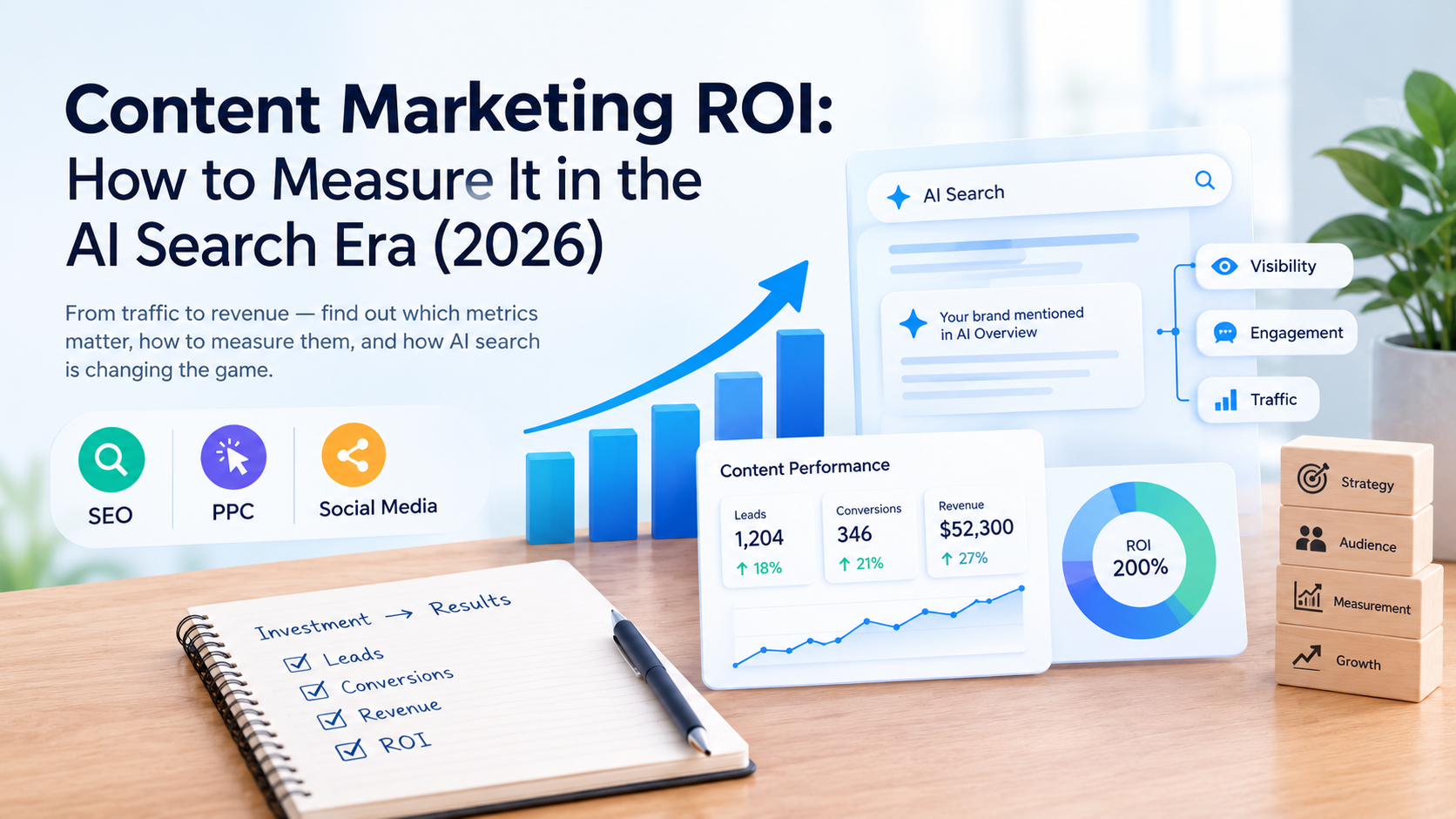
Traffic is up, but leads are flat? Clicks are down, but your brand keeps showing up in AI answers? Welcome to content measurement in 2026.
Page views and rankings alone no longer prove that content is paying off. Here is a practical, no-fluff way to measure content marketing ROI and connect content to real business results.
 Quick example:
Quick Answer
- Formula: ROI = [(Attributed Revenue − Content Cost) ÷ Content Cost] × 100
- Count the full cost: writers, editors, SEO, design, tools, promotion, and updates
- Track outcomes first: qualified leads, pipeline, and closed-won revenue
- Treat AI visibility as a supporting signal, not proof of revenue
- Review at 30, 60, and 90 days (longer if your sales cycle is long)
What Is Content Marketing ROI?
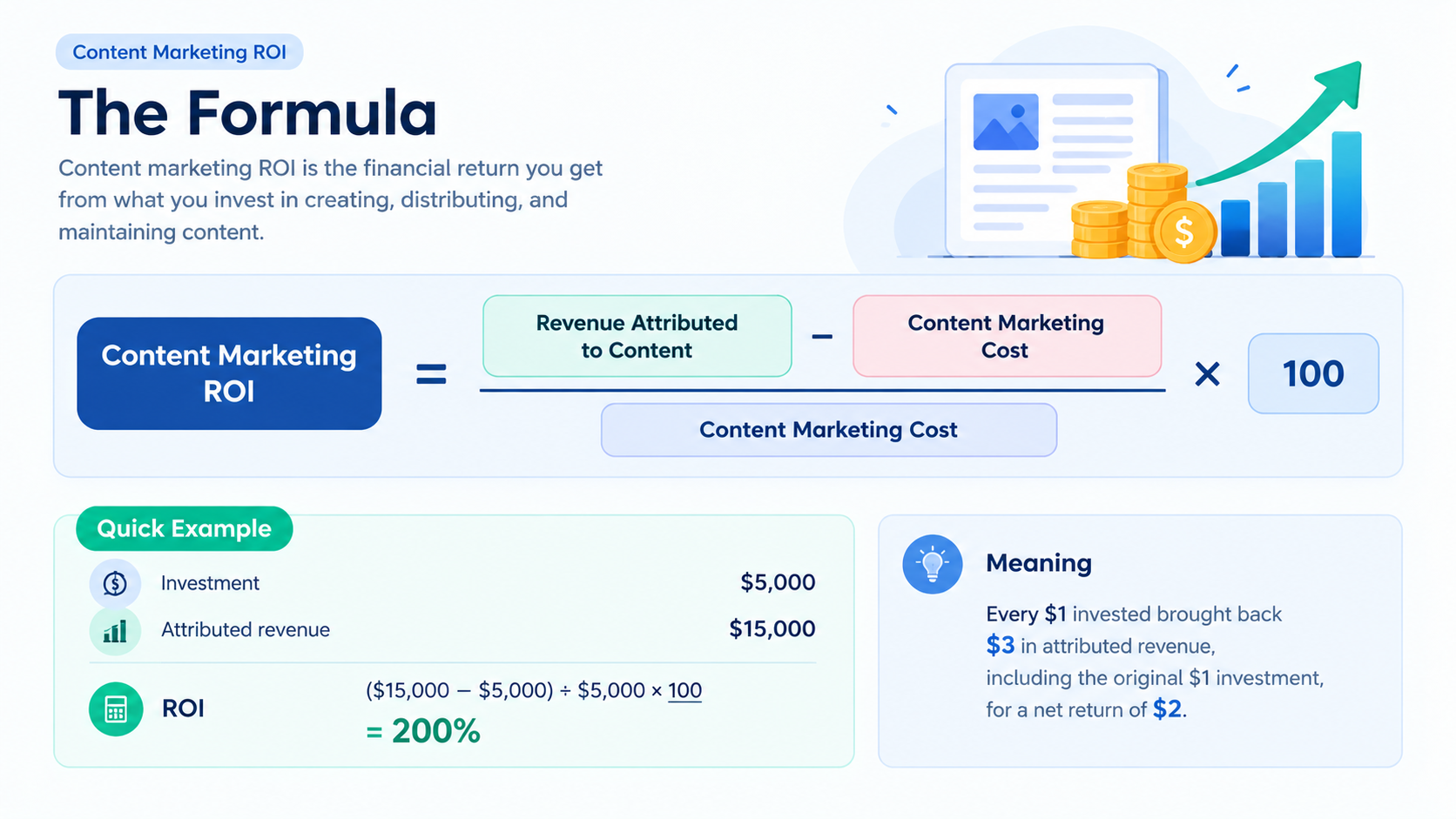
Content marketing ROI is the financial return you get from what you invest in creating, distributing, and maintaining content. The formula: Content Marketing ROI = [(Revenue Attributed to Content − Content Marketing Cost) ÷ Content Marketing Cost] × 100
Quick example:
- Investment: $5,000
- Attributed revenue: $15,000
- ROI = [($15,000 − $5,000) ÷ $5,000] × 100 = 200%
- Meaning: every $1 invested brought back $3 in attributed revenue ($2 net return)
- Revenue is not profit. For a stricter view, use gross profit instead of revenue, or subtract delivery, sales, and service costs.
- Attribution matters. If a buyer reads a blog, attends a webinar, and then talks to sales, the blog should not get 100% of the credit. Always explain how credit was assigned.
- ROI is not ROAS. ROAS compares ad revenue with ad spend only. ROI also includes production, tools, and team costs.
Why ROI Looks Different in the AI Search Era
People now discover brands through Google AI Overviews, AI Mode, and conversational search tools, often before they ever click a link. That is why Answer Engine Optimization has become part of many content strategies.What Google says:
- Standard SEO fundamentals still apply to AI features in Search
- No special technical requirements are needed to appear in AI Overviews or AI Mode
- Pages must be eligible for Google Search, and content should be useful, reliable, and people-first
- Traffic from AI features is counted in the overall Web search report in Search Console
What this means for you:
- Business outcomes: track qualified leads, opportunities, sales, and retention
- Search visibility: monitor impressions, clicks, queries, and brand mentions in AI answers where you can observe them
- Content influence: measure how educational content helps buyers before they convert, even if it is not the last touchpoint
What the Data Says
Source: Content Marketing Institute — B2B Content Marketing Benchmarks, Budgets, and Trends: Outlook for 2025 (980 B2B marketers surveyed in 2024)- 56% of B2B marketers who measure content performance say attributing ROI to content is a challenge
- 56% also struggle with tracking customer journeys
- 87% said content helped them build brand awareness
- 74% said it helped generate demand or leads
- 49% said it helped generate sales or revenue
- Content clearly works at the top of the funnel
- Proving its link to revenue is much harder
- Measure what you can attribute directly and the influence you can reasonably observe
- Do not treat every impression as revenue, and do not ignore assisted conversions either
How to Measure Content Marketing ROI: 7 Steps
1. Set a clear goal before you publish
- Match every asset to one business objective
- Pick one primary KPI and a few supporting metrics
- Examples:
- Educational blog → relevant organic visitors
- Industry guide → qualified leads
- Comparison article → helps prospects evaluate options
- Case study → supports sales conversations
- Troubleshooting article → fewer repetitive support tickets
2. Calculate the full cost
- Strategy and topic research
- Writer, editor, and expert time
- SEO research and optimization
- Design, photos, and video
- Content management and analytics tools
- Paid promotion and distribution, such as PPC campaigns
- Updates, fact-checking, and maintenance
3. Track qualified traffic, not just page views
- 10,000 visitors with no buying intent can be worth less than 800 highly relevant ones
- Watch:
- Organic clicks and impressions (Google Search Console)
- Relevant landing-page sessions (GA4)
- New vs returning visitors
- Visits to product, pricing, and contact pages
- Referral traffic from relevant sites and platforms
- Engagement time and scroll depth only matter when tied to a next step, like a demo request or download
4. Measure leads and conversions
- Set up conversion events for:
- Contact form submissions
- Demo requests
- Consultation bookings
- Meaningful resource downloads
- Newsletter sign-ups
- Trial registrations
- Purchases or qualified sales inquiries
- Not all conversions are equal: a demo request is closer to buying than a newsletter sign-up
- Connect analytics to your CRM to follow leads through qualification, opportunity, and closed-won revenue
5. Connect content to revenue
- Buyers rarely follow a straight line: article → newsletter → case study → demo
- Compare attribution models:
- First-touch: credits the first interaction
- Last-touch: credits the final interaction
- Multi-touch: spreads credit across interactions
- No model is perfect. Cookie limits, consent choices, and cross-device journeys create gaps
- Use attribution as a decision-making tool, not a complete record
6. Measure performance in AI search
- Google Search Console: impressions, clicks, CTR, position and queries
- GA4: referral sources, landing pages and conversions from identifiable AI-related traffic. Some AI-assisted visits will not show up cleanly
- Manual AI visibility checks:
- Test real buyer questions in selected AI search tools
- Record whether your brand appears, which pages are cited, and which competitors show up
- Repeat on a schedule, since results vary by query, location, personalization, and time
- CRM and sales feedback: ask leads “How did you find us?” and which resources helped
7. Review performance over time
- Check at 30, 60, and 90 days; competitive niches and long sales cycles may need longer
- Look for:
- Pages producing qualified conversions
- High-traffic pages with weak conversion
- Content attracting the wrong audience
- Declining pages that need an update
- Articles that could support product or sales pages
- Topics worth more research or distribution
- Reporting should decide what to improve, update, promote, or stop
Content Marketing Metrics to Track in 2026
- Content marketing ROI: return relative to investment. Best for campaign and portfolio review.
- Attributed revenue: revenue credited under your model. Best for commercial reporting.
- Qualified leads: prospects who meet your criteria. Best for B2B lead generation.
- Lead-to-customer rate: how well leads become customers. Best for funnel evaluation.
- Organic clicks and impressions: search traffic and visibility. Best for SEO performance.
- Conversion rate: share of visitors who take action. Best for landing-page optimization.
- Cost per lead: content investment ÷ attributed leads. Best for lead-gen efficiency.
- Assisted conversions: conversions where content helped earlier in the journey. Best for measuring content influence.
- AI citations and brand mentions: presence in selected AI answers (a directional signal, not proof of revenue). Best for AI visibility monitoring.
- Retention or support outcomes: whether content helps existing customers. Best for customer education.
Real-World Style Example
A B2B software company runs a 3-month campaign: 6 articles, graphics, SEO, and distribution.- Content creation and research: $3,000
- Design, tools, and distribution: $1,000
- Total investment: $4,000
- Attributed closed-won revenue: $12,000
- Net return: $8,000
- ROI: 200%
- These are illustrative numbers, not a real company or benchmark
- $12,000 is revenue under a defined attribution model
- Also report qualified leads, conversion rates, organic performance, and AI visibility to explain why the campaign worked
How to Improve Content Marketing ROI in 2026
More content is not always the answer. Make what you have work harder.- Refresh what already performs: update outdated stats, add original insights, fix weak CTAs, and improve internal links
- Lead with expertise: invest in expert-led content writing with expert input, customer questions, first-hand experience, and verified data. Generic AI-style content is easy to copy
- Match search intent: definitions need guides, comparisons need case studies and tables. Not every page needs the same conversion goal
- Fix conversion paths: link naturally to product pages, resources, and consultation options without annoying the reader
- Use AI as an assistant: great for clustering topics, outlines, and gap analysis. Humans still own accuracy, originality, and brand voice
- Build measurement into publishing: before going live, define success, confirm tracking, record cost, and set a review date


Share This Post :